Chinese Name Definition: Structure, Meaning & Cultural Guide
Ever met someone named 沐宸 (Mùchén) or 若汐 (Ruòxī) and thought, "Okay… that sounds pretty, but what does it mean?" Here's the fun part: a Chinese name usually isn't "just a label." It's a tiny bundle of family history, personal hopes, and cultural taste—packed into 2–3 characters.
So if you're Googling "Chinese name definition," you're basically asking: How are Chinese names built, and what are people trying to say with them? Let's make it simple (and actually useful).
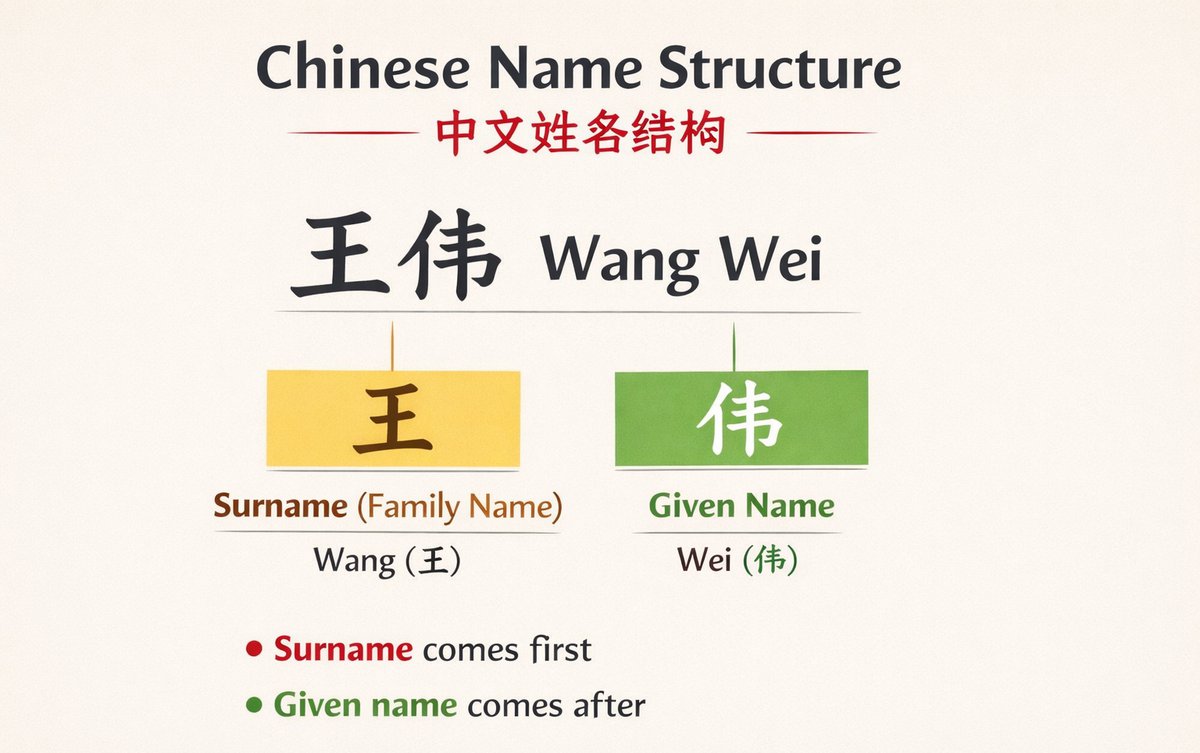
1) The simplest definition: xìngmíng is "surname + given name"
A Chinese full name is called 姓名 (xìngmíng). The structure is usually:
- 姓 (xìng) = family name / surname (usually 1 character)
- 名 (míng) = given name (usually 1–2 characters)
And yes—the family name comes first. That's not a "style choice." It's the default logic: family first, then the individual.
| What you see | Chinese characters | Pinyin | Meaning (plain English) |
|---|---|---|---|
| Family name (surname) | 王 | Wáng | "Wang" (a common surname) |
| Given name | 小明 | Xiǎomíng | "little bright / small & clever" vibe |
| Full name (Chinese order) | 王小明 | Wáng Xiǎomíng | Wang + Xiaoming |
When written in Roman letters, the same given name might show up as Xiaoming, Xiao Ming, or Xiao-Ming. It's still one given name—just different formatting.
Speaking of surnames—if you're choosing a Chinese name and need a complete surname reference with meanings and origins, that can save you from accidentally picking something awkward.
2) What "a good Chinese name" is trying to do
Parents aren't only picking something that sounds nice. A strong Chinese name usually balances four things: meaning, sound, culture, and real-world usability.
Meaning: the "wish" hidden in the characters
This is the big one. A name often carries a blessing or expectation—like character traits, life direction, or a vibe parents want their kid to grow into.
- 品德期望 (pǐndé qīwàng) — virtue and moral expectations: 诚 (chéng) honest, 谦 (qiān) humble, 仁 (rén) kind
- 自然意象 (zìrán yìxiàng) — nature imagery: 晨 (chén) morning, 竹 (zhú) bamboo, 雨 (yǔ) rain. For example, if you love botanical symbolism, names inspired by flowers offer elegant, culturally-rooted options.
- 抱负志向 (bàofù zhìxiàng) — aspirations and ambitions: 博 (bó) learned, 睿 (ruì) wise, 翔 (xiáng) soar
Sound: you're avoiding "mouth-twister + accidental joke"
Chinese names care about rhythm and how it sounds when spoken fast. Also: homophones are a real hazard.
Classic cautionary tale: 杜子腾 (Dù Zǐténg) can sound like 肚子疼 (dùzi téng) ("stomach ache"). That's the kind of thing kids never forget.
Culture: poetry, classics, and "this name has a backbone"
Pulling characters from classics is a long-standing move. People borrow from 《诗经》 (Shījīng) — the Classic of Poetry, 《楚辞》 (Chǔcí) — Songs of Chu, and Tang/Song poetry 唐诗宋词 (Tángshī Sòngcí) because the imagery is clean and the vibe is timeless.
Usability: the modern "don't make life harder" rule
Even a beautiful character can be a daily headache if it's too rare to type, easy to misread, or constantly mispronounced. These days, many families prefer names that are distinct but not obscure.
3) A quick reality check: popular names become popular FAST
People love to say "I want a unique name." Then half the country falls in love with the same two characters.
Example: In the 2021 national household-registration stats, 8.873 million newborns were registered that year, and the top names were used by tens of thousands of babies.
- 沐宸 (Mùchén): used by about 23,000 baby boys
- 若汐 (Ruòxī): used by about 18,000 baby girls
And this is why "sounds rare to me" isn't a strategy. It's a guess.
Another useful data point: across China's registered population, two-character given names dominate—about 84.55% are two-character names, while 13.97% are single-character names (with a small slice using other lengths). That "two-character elegance" you notice? It's the norm.
4) Name examples with meaning (male, female, and flexible)
Here are names that are actually usable (not fantasy-novel-only), grouped by the feeling they give off. I'll write them as surname + given name, with pinyin and the "why it works."
For boys: bright, steady, ambitious
- 李浩然 (Lǐ Hàorán) — "vast + upright." It feels open, confident, and clean.
- 陈奕辰 (Chén Yìchén) — "brilliant presence." Modern, sharp, and easy to remember.
- 周宇轩 (Zhōu Yǔxuān) — "universe + lofty pavilion." Big-picture energy, very contemporary.
- 赵弘毅 (Zhào Hóngyì) — "broad + resolute." Strong, classic, and a little scholarly.
If you like celestial imagery with real cultural depth, check out these star-inspired Chinese names that feel elegant without being over-the-top.
For girls: graceful, poetic, strong in a quiet way
- 王若汐 (Wáng Ruòxī) — "like + evening tide." Soft, elegant, and very image-rich.
- 林雨桐 (Lín Yǔtóng) — "rain + parasol tree." Poetic and calm, like a scene from a poem.
- 刘艺涵 (Liú Yìhán) — "art + depth." Feels modern and capable, not overly "sweet."
- 张瑾瑜 (Zhāng Jǐnyú) — "fine jade." Classic symbolism: precious, refined, valuable.
Gender-flexible: modern and clean
- 许安然 (Xǔ Ānrán) — "peaceful, at ease." Works for anyone; it's calm and confident.
- 唐子墨 (Táng Zǐmò) — "scholarly + ink." Trendy, artsy, and still readable.
5) The deeper layers: what makes a Chinese name culturally "correct"
Understanding Chinese names goes beyond just knowing the structure. There's a whole layer of cultural logic that governs how names are perceived and evaluated.
Character composition matters: radicals tell a story
Each Chinese character is built from components called 部首 (bùshǒu) — radicals. These aren't just random strokes—they carry semantic meaning that can influence a name's feel.
For example:
- Characters with 氵(water radical) like 汐 (xī), 涵 (hán), 澜 (lán) — suggest flow, adaptability, wisdom
- Characters with 木 (wood radical) like 林 (lín), 桐 (tóng), 梓 (zǐ) — evoke growth, vitality, natural strength
- Characters with 王 (jade radical) like 瑾 (jǐn), 瑜 (yú), 琪 (qí) — symbolize preciousness, refinement, value
- Characters with 日 (sun radical) like 晨 (chén), 昊 (hào), 晖 (huī) — represent brightness, clarity, positivity
Skilled namers often balance radicals across a two-character given name to avoid visual redundancy while maintaining thematic coherence.
Stroke count and balance: the visual aesthetics
Chinese names are also judged by how they look when written. Names with extremely unbalanced stroke counts—like pairing a 3-stroke character with a 23-stroke character—can feel visually awkward.
The aesthetic principle is 平衡 (pínghéng) — balance. For example:
- 李 (7 strokes) + 浩 (10) + 然 (12) — visually harmonious progression
- 王 (4) + 瑾 (15) + 瑜 (13) — balanced despite the surname being simpler
Generational naming systems: zìbèi pái
Some families follow a 字辈排 (zìbèi pái) — generational naming poem, a pre-written verse where each line represents a generation. All children in that generation share one character from the assigned line.
For example, if the generational poem line is "文武忠孝":
- First generation: all names include 文 (wén) — "literary, cultured"
- Second generation: all names include 武 (wǔ) — "martial, brave"
- Third generation: all names include 忠 (zhōng) — "loyal"
- Fourth generation: all names include 孝 (xiào) — "filial piety"
This practice is less common in modern urban families but remains strong in traditional or rural communities.
6) How to choose a Chinese name (a practical 3-step method)
This works whether you're naming a baby or picking a Chinese name for yourself.
-
Pick the "message" first
Choose 1–2 themes: character (e.g., 诚 (chéng) — honesty), nature (e.g., 竹 (zhú) — bamboo), ambition (e.g., 翔 (xiáng) — to soar), calm (e.g., 安 (ān) — peace).
-
Say it out loud like you're calling them in a crowded room
If it's awkward to pronounce quickly, it'll be awkward forever. Also test for bad homophones.
-
Stress-test it for real life
Can people type it easily? Will it break systems? Will it be misread constantly? Pretty matters—but so does daily convenience.
If you want to experiment with different combinations and see how they work together, try using a Chinese name generator that lets you customize meaning, style, and cultural preferences.
7) Traditions you'll hear about (and how "serious" they are today)
Generation names: bèifèn zì
Some families share a "generation character" called 辈分字 (bèifèn zì) — generational marker. Siblings or cousins might all share one character to show lineage.
Five elements and bāzì naming
You'll also hear about 五行 (wǔxíng) — Five Elements (Metal, Wood, Water, Fire, Earth) and 八字 (bāzì) — Eight Characters (birth time-based fortune analysis). Some families consult for balance; others ignore it completely. It's cultural, not mandatory.
The theory works like this: your birth time corresponds to certain elements. If you're "missing" an element (say, Water), you might add a Water-related character to your name to restore balance. Characters like 海 (hǎi — ocean), 雨 (yǔ — rain), or 泽 (zé — marsh) would be considered Water names.
Avoiding ancestors' names: bì huì
Traditional practice includes 避讳 (bì huì) — name taboo, which means you don't use the exact same characters as revered ancestors or elders. This practice has softened in modern times, but it's still considered respectful in many families to avoid direct name collisions with grandparents or great-grandparents.
8) Regional and dialect considerations
A name that sounds beautiful in Mandarin might sound completely different—or awkward—in regional dialects like Cantonese, Hokkien, or Shanghainese.
For example:
- 思琪 (Sīqí) sounds elegant in Mandarin, but in some Cantonese pronunciations it might sound close to unflattering homophones.
- 家豪 (Jiāháo) works smoothly across most dialects.
If your family speaks a dialect at home, test the name in that pronunciation before finalizing it.
9) Common Chinese name FAQ (fast answers)
Do Chinese people have middle names?
Not in the Western sense. A two-character given name can look like "first + middle," but it's one unit.
Why is the surname first?
It reflects tradition and language structure. In Chinese contexts, swapping the order can feel strange. The family unit is emphasized before individual identity.
Do women change their surname after marriage?
Usually no. In mainland China, women legally keep their birth surname. Some may socially add the husband's surname in front in formal contexts (e.g., 李王雪梅 — "Li [husband's surname] Wang Xuemei"), but this is optional and increasingly rare.
What's the best way to write pinyin in English?
Use standard Hànyǔ Pīnyīn formatting, and keep the given name together if possible (e.g., Ruoxi rather than Ruo Xi) so it reads as one name.
Should I include tone marks (like Ruòxī) in daily use?
For learning and clarity: yes. For passports and forms: usually no. Tone marks often get removed in official Romanization.
Are rare characters a problem?
They can be. Some systems may not support uncommon characters, which turns your "unique" name into paperwork drama. China's national character database has limitations, and using ultra-rare characters can cause issues with ID cards, banking systems, and digital forms.
Can foreigners choose a Chinese name?
Absolutely. Best practice: pick characters for meaning first, then make sure locals can pronounce it naturally. Avoid transliteration-only names (like 麦克 Màikè for "Mike") if you want something that feels culturally integrated.
Is it okay to copy a celebrity's name?
You can, but it often feels gimmicky. A name that fits your personality lands better than a name that screams fandom.
What if my surname is rare or unusual?
Rare surnames (like 上官 Shàngguān, 司徒 Sītú — compound surnames, or 尉迟 Yùchí, 长孙 Zhǎngsūn) require extra care in choosing a given name. Make sure the full name doesn't sound awkward or create unintended homophones when said quickly.
How do Chinese people write their names in English?
There's variation. Some keep Chinese order (Wang Xiaoming), some flip it (Xiaoming Wang), and some add a Western first name (Michael Wang). For professional or international contexts, the flipped order or hybrid approach is common.
10) Why understanding Chinese names matters (beyond just translation)
When you understand the definition and structure of Chinese names, you're not just learning vocabulary—you're getting insight into how a culture thinks about identity, family, and legacy.
A Chinese name isn't arbitrary. It's:
- A family statement — linking you to ancestors and your generational role
- A personal prophecy — parents encoding hopes, values, and expectations
- A cultural artifact — reflecting aesthetic trends, literary traditions, and philosophical ideas
- A daily lived experience — affecting how you're perceived, pronounced, and remembered
That's why the question "What does a Chinese name mean?" deserves more than a one-line answer. It's a layered system that rewards deeper exploration.
Quick takeaways (if you're skimming)
- Chinese name definition = 姓名 (xìngmíng) = surname (姓 xìng) + given name (名 míng).
- Most given names are two characters, and that's not new—it's mainstream (84.55% of all names).
- A "good" name balances meaning, sound, culture, and real-life usability.
- Character radicals, stroke balance, and tonal harmony all play a role in name quality.
- Regional dialects, generational systems, and Five Elements theory add extra layers of consideration.
- If you want uniqueness, don't rely on vibes—check popularity data, test pronunciation across dialects, and verify character compatibility.