45 Chinese Pet Names for Lovers (With Pinyin): From 宝贝 to 老公 — What They Really Signal
The fastest way to make your Chinese partner cringe
If you call someone 老公 (lǎogōng) or 老婆 (lǎopó) too early, it doesn’t sound “extra romantic” — it can sound like you just promoted them to spouse without consent, and that pressure lands hard. I don’t recommend using spouse-coded titles until you’ve had at least 1 explicit “we’re serious” talk, because the consequence is awkward silence, not cute vibes.
Copy/paste first: 45 internet-style couple nicknames (with pinyin + who says it)
These are the ones that show up constantly in texting and contact names, but I reject a bunch of them for spoken, real-life use because they can sound childish or “customer-service flirty.” Treat this as a menu: pick 1–2, test them privately, and drop anything that gets a weird pause back.
| Chinese | Pinyin | Who says it | What it feels like | Best stage | Misuse risk |
|---|---|---|---|---|---|
| 宝子 | bǎozi | Either → either | Trendy “babe” vibe | Early–steady (text) | Can feel fake if you’re not close |
| 宝贝 | bǎobèi | Either → either | Classic sweet | Any stage | Also used by sales people (“亲密但不一定真亲密”) |
| 宝宝 | bǎobǎo | Either → either | Very cutesy | Steady (private) | Can sound childlike in public |
| 亲爱的 | qīn’ài de | Either → either | “Dear” (warmer than it looks) | Steady | Too serious for day-3 dating |
| 亲 | qīn | Either → either | Taobao-style cute | Inside joke only | I avoid it early: sounds like a shopkeeper |
| 亲亲 | qīnqīn | Either → either | Flirty “kiss-kiss” | Steady (text) | Cringe if said aloud |
| 么么哒 | mēmēdā | Either → either | Text-only kissy | Flirty (text) | Feels performative in speech |
| 抱抱 | bàobào | Either → either | “Hug-hug” needy-cute | Steady (private) | Can read as baby-talk |
| 啵啵 | bōbō | Either → either | Cartoon kiss sound | Text only | Sounds like a meme out loud |
| 小可爱 | xiǎo kě’ài | Either → either | Playful “cutie” | Early–steady | Overuse makes you sound unserious |
| 小甜心 | xiǎo tiánxīn | Either → either | Soft “sweetheart” | Early–steady | Too syrupy for formal people |
| 甜心 | tiánxīn | Either → either | Short “sweetie” | Steady | Can feel scripted if you never speak cute |
| 小宝贝 | xiǎo bǎobèi | Either → either | Extra affectionate | Steady | Public use can embarrass people |
| 乖乖 | guāiguāi | Either → either | “Good one” / soothing | Comfort moments | Can feel patronizing if used in arguments |
| 崽崽 | zǎizǎi | Either → either | Super intimate cute | Steady (private) | I avoid it with 30+: may feel childish |
| 我的宝 | wǒ de bǎo | Either → either | Possessive-cute | Steady | “Mine” can feel clingy fast |
| 我的那位 | wǒ de nà wèi | Either → either | Low-key “my person” | Steady (public OK) | None, if your tone is natural |
| 我家那位 | wǒjiā nà wèi | Either → either | Cozy “the one at my place” | Steady–married | Using it early implies cohabitation |
| 对象 | duìxiàng | Either → either | Very real-life “partner” | Any stage | Sounds blunt, not poetic |
| 男朋友 | nán péngyou | Either → male partner | Plain “boyfriend” | Official dating | Feels distant as a pet name |
| 女朋友 | nǚ péngyou | Either → female partner | Plain “girlfriend” | Official dating | Feels distant as a pet name |
| 男票 | nánpiào | Either → male partner | Internet-slang boyfriend | Early–steady (text) | Can feel immature in serious talk |
| 女票 | nǚpiào | nǚpiào | Internet-slang girlfriend | Early–steady (text) | Same: a bit juvenile |
| 哥哥 | gēge | Usually F → M | Flirty, slightly “spoiled” | Flirty (private) | Can read as age-gap/roleplay |
| 妹妹 | mèimei | Usually M → F | Flirty, protective | Flirty (private) | Feels condescending to some women |
| 小姐姐 | xiǎo jiějie | Either → F | Friendly-flirty | Early (light) | Sounds like flirting with a stranger if too soon |
| 小哥哥 | xiǎo gēge | Either → M | Friendly-flirty | Early (light) | Can sound like streaming/chat culture |
| 笨蛋 | bèndàn | Either → either | Teasing “dummy” | Steady | Mean if your tone isn’t warm |
| 傻瓜 | shǎguā | Either → either | Teasing “silly” | Steady | Bad during conflict: sounds dismissive |
| 坏蛋 | huàidàn | Either → either | Playful “bad one” | Flirty–steady | Cringe if you don’t flirt naturally |
| 小坏蛋 | xiǎo huàidàn | Either → either | Even cuter teasing | Flirty (private) | Sounds childish in public |
| 猪猪 | zhūzhū | Either → either | Playful “piggy” | Steady (private) | Body-image sensitive: don’t assume it’s okay |
| 小猪 | xiǎo zhū | Either → either | Short piggy | Steady (private) | Same risk: can insult |
| 大猪蹄子 | dà zhū tízi | Usually F → M | Teasing “jerk” meme | Inside joke | I avoid it unless they already use it |
| 小祖宗 | xiǎo zǔzōng | Either → either | “My little boss” | Steady | Can sound like you’re enabling tantrums |
| 小醋精 | xiǎo cùjīng | Either → either | Teasing “jealous one” | Steady | Risky if jealousy is a real issue |
| 醋坛子 | cùtánzi | Either → either | Stronger “jealous pot” | Steady (joking) | Can escalate fights |
| 憨憨 | hānhān | Either → either | Soft “goof” | Steady | Some people hear “not smart” |
| 呆子 | dāizi | Either → either | Teasing “dork” | Steady | Same: tone matters |
| 木头 | mùtou | Either → either | “Block of wood” (slow) | Steady | Can hurt if they’re insecure |
| 心肝 | xīngān | Either → either | Old-school intense affection | Steady–married (private) | Sounds dramatic to some young people |
| 小心肝 | xiǎo xīngān | Either → either | Even more “cherish” | Steady (private) | Can feel theatrical |
| 领导 | lǐngdǎo | Either → either | Joking “boss” | Inside joke | Confusing around friends/colleagues |
| 老板 | lǎobǎn | Either → either | Joking “boss/owner” | Inside joke | Sounds like service industry talk |
| 充电宝 | chōngdiànbǎo | Either → either | Contact-name meme (“power bank”) | Contact only | I reject it as spoken name: sounds odd |
| 饭票 | fànpiào | Either → either | “Meal ticket” joke | Contact only | Can feel transactional |
| 室友 | shìyǒu | Either → either | “Roommate” cover joke | Secret/inside joke | Can backfire if families hear it |
| 老婆大人 | lǎopó dàrén | Usually M → F | Playful “my lady” | Married/very steady | Too much if you’re not committed |
| 老公大人 | lǎogōng dàrén | Usually F → M | Playful “sir hubby” | Married/very steady | Same: commitment-coded |
Here’s the catch: a nickname that works in chat can sound ridiculous out loud, so I treat “text-only” as a real category, not a footnote. If you want one that rarely backfires, start with 1 neutral option (宝贝 bǎobèi / 对象 duìxiàng / 我的那位 wǒ de nà wèi) and avoid roleplay-coded ones until they introduce them first.
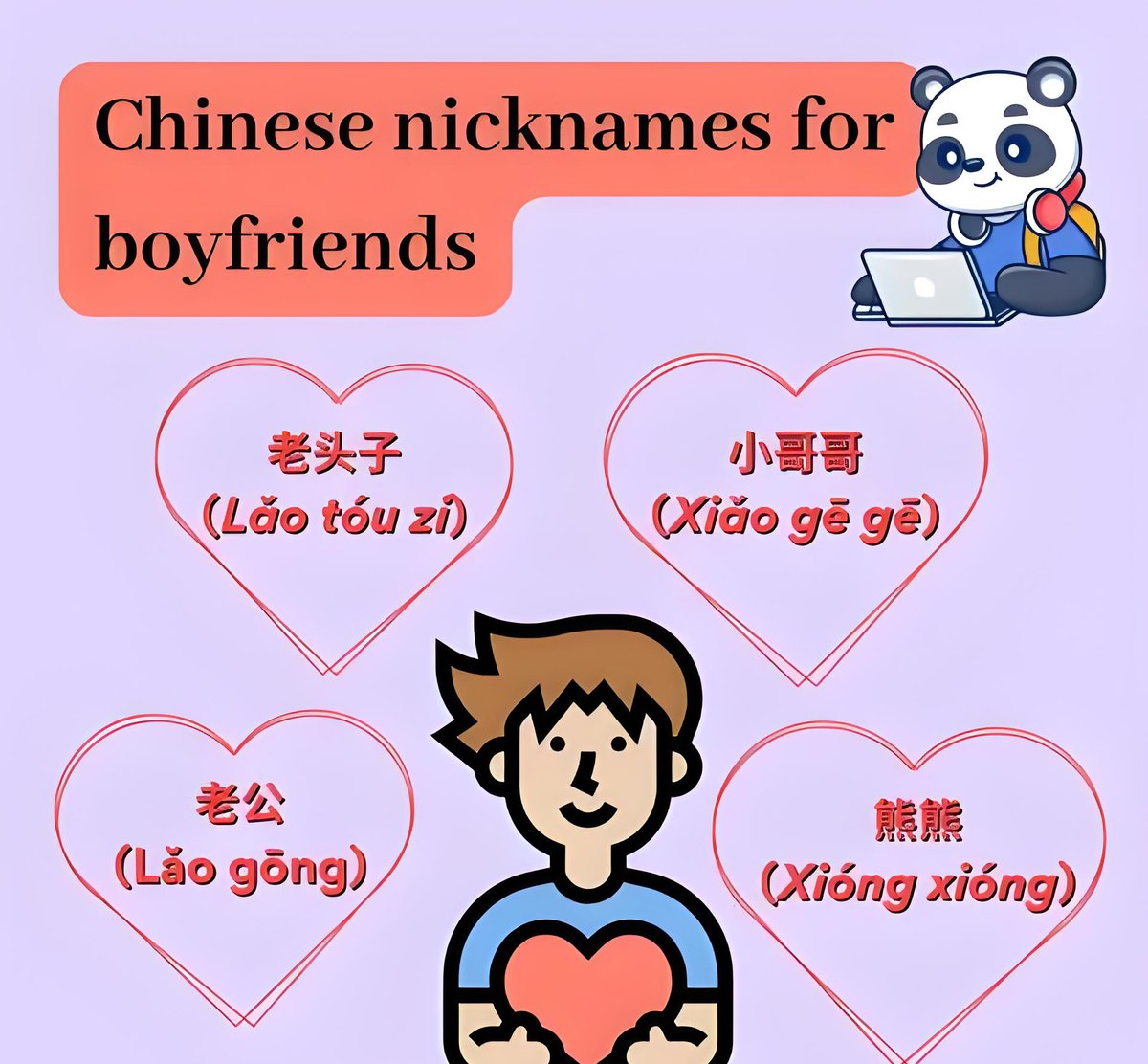
What these nicknames signal to native speakers (not the dictionary meaning)
I reject “literal translation thinking” because Chinese pet names are more about relationship posture than vocabulary, and the consequence is sounding like you copied a drama script. In real use, the same word can be sweet in private and cringe in public, so you need a setting filter, not just a word list.
- Neutral intimacy (low risk): 宝贝 bǎobèi, 对象 duìxiàng, 我的那位 wǒ de nà wèi
- Baby-talk intimacy (high privacy): 宝宝 bǎobǎo, 抱抱 bàobào, 崽崽 zǎizǎi
- Teasing affection (tone-dependent): 笨蛋 bèndàn, 傻瓜 shǎguā, 憨憨 hānhān
- Roleplay / performance (ask first): 哥哥 gēge, 老婆大人 lǎopó dàrén, 夫君 fūjūn
- Public-safe “official” labels (not cute): 男朋友 nán péngyou, 女朋友 nǚ péngyou
If your partner is the “don’t be cringe” type, I avoid baby-talk categories entirely because the consequence is them feeling like you’re talking to a child. If your partner is openly cute in Chinese already, then 1–2 baby-talk terms can work, but only in private.
Commitment-coded titles: sweet for spouses, pushy for new couples
I don’t recommend spouse-coded titles as “flirting,” because in Mandarin they often sound like a claim, not a compliment, and the consequence is instant awkwardness. If you want commitment language, choose a softer step first (亲爱的 qīn’ài de or 我家那位 wǒjiā nà wèi) before you jump to “husband/wife.”
| Chinese | Pinyin | Typical direction | When it’s normal | When it backfires |
|---|---|---|---|---|
| 老公 | lǎogōng | Usually F → M | Engaged/married, or clearly committed | Early dating: sounds like forced commitment |
| 老婆 | lǎopó | Usually M → F | Engaged/married, or clearly committed | Early dating: can feel possessive |
| 媳妇儿 | xífùr | Usually M → F | Married / northern-style casual | Also means “daughter-in-law”: family context confusion |
| 爱人 | àirén | Either → either | More formal/public, older-style | Can sound bureaucratic or “official” |
| 老伴 | lǎobàn | Either → either | 50+ long-term couples | 20s: makes you sound 40 years older |
Ancient / period-drama terms: what they meant, and why they’re risky now
These words are real, but I reject them as “default romantic” because most modern listeners hear cosplay, not intimacy, and the consequence is you sounding like you’re acting. They only work if both of you are intentionally playing a historical/fiction vibe, and you keep it private.
| Term | Pinyin | Historical vibe (roughly) | Modern ear hears | My usage rule |
|---|---|---|---|---|
| 相公 | xiànggōng | Honorific for high officials; later “husband” in opera/folk usage | Costume drama / playful old-timey | I avoid it unless your partner uses it first |
| 官人 | guānrén | Old address term; often seen in classics/novels | Historical roleplay, sometimes comedic | Don’t use in serious talk; it reads like a skit |
| 夫君 | fūjūn | Formal “husband” in classical writing | Very scripted, very “drama” | Safe only as intentional roleplay |
| 郎君 | lángjūn | Young man / husband term in older usage | Poetic, distant | Don’t use as a daily nickname |
| 良人 | liángrén | Spouses could call each other this in early texts | Poetry word, not a pet name | Works in writing; awkward in speech |
| 卿 | qīng | Classical intimate “you/dear” between close people | Archaic, a bit “trying hard” | Only use if your Chinese is strong enough to carry it |
| 娘子 | niángzi | Woman term; later “wife” in many stories | Historical, sometimes playful | Risky: can sound like you’re quoting TV |
| 内人 | nèirén | Traditionally “my wife” when speaking to others | Old-fashioned, formal | Don’t address your partner as 内人 directly |
| 外子 | wàizi | Traditionally “my husband” when speaking to others | Old-fashioned, formal | Don’t address your partner as 外子 directly |
If you still want an “ancient” flavor with lower risk, use exactly 1 term in a clearly playful moment and drop it if they don’t mirror it back within 2 tries. If they laugh but don’t reuse it, that’s your answer, and pushing it makes you sound stubborn, not romantic.

Age and setting matter more than the word (20s vs 30s vs 50+)
I don’t recommend choosing a nickname without an age/setting check, because the consequence is sounding either childish or oddly formal. Think of it as 3 buckets: “cute-private,” “neutral-everywhere,” and “public-safe but not cute.”
- 20s dating: 宝贝 bǎobèi and 小可爱 xiǎo kě’ài are safer than 老公 lǎogōng, because early commitment talk can feel heavy.
- 30s dating: 我的那位 wǒ de nà wèi and 亲爱的 qīn’ài de often land better than 宝宝 bǎobǎo, which can feel too babyish.
- 50+ long-term: 老伴 lǎobàn is normal and warm, but using it in your 20s makes you sound like you’re joking about marriage or age.
- Public / around family: 对象 duìxiàng or 男/女朋友 are clearer, because “猪猪 zhūzhū” can embarrass people fast.
Foreigners (and overseas Chinese) mess these up a lot: 7 “don’t do this” rules
I actively filter these out because they cause the most misunderstanding, and the consequence is you sounding like you don’t understand relationship boundaries. If you only remember 7 things, make it these.
- Don’t open with 亲 (qīn). It’s widely used in commerce, so it can sound like you’re doing a sales script, not intimacy.
- Don’t use 老公/老婆 as “cute flirting” on week 1. It can read like a claim, and people will pull back.
- Don’t assume pig nicknames are safe. 猪猪 (zhūzhū) can be affectionate, but for some people it hits body-image nerves and becomes an insult.
- Don’t use 哥哥/妹妹 unless you know the vibe. It can signal roleplay, age-gap flirting, or internet culture, which some adults hate.
- Don’t address your partner as 内人/外子. Those are traditionally “about my spouse” to a third party, so saying it to their face sounds off.
- Don’t copy historical words for “authenticity.” 相公/官人/夫君 usually sound like TV dialogue, and the cringe is immediate if your accent isn’t strong.
- Don’t pick a nickname you can’t say smoothly. Bad tones make even a normal word sound unnatural, and people notice within 1 sentence.
A practical 5-question checklist (use this, not vibes)
I use these 5 checks because they prevent the most common mistakes, and the consequence of skipping them is choosing a nickname that only works in fiction. Answer them honestly and you’ll land on something that feels normal.
- Is this “text-only”? If yes (么么哒 / 啵啵), I keep it out of real speech.
- Does it imply marriage? If yes (老公/老婆/媳妇儿), I wait until commitment is explicit.
- Could it sound like customer service? If yes (亲 / 宝贝 in some contexts), I use it only if your partner already uses it with you.
- Is it teasing? If yes (笨蛋/傻瓜/猪猪), I only use it after I’ve seen them joke the same way.
- Would you say it in front of their friends? If no, keep it private, because public embarrassment kills affection fast.
One-sentence rule
Pick a nickname that matches your relationship stage, then cut anything that sounds like roleplay or pressure — because “cute” that triggers cringe isn’t cute, it’s friction.